The wedding's over. You danced, you cried, you ate cake, you left in a shower of sparklers (or bubbles, or nothing because it was 11 PM and everyone was tired — no judgment).
Now you're on a flight to your honeymoon, scrolling Instagram, and a thought hits you:
When do I get my photos?
This is the part nobody explains. Your photographer said "4–6 weeks" and you nodded because you were too busy planning the actual wedding to ask follow-up questions. Fair enough.
Here's what's actually happening during those weeks, and why your photographer isn't just sitting on your photos being lazy. I promise.
Night of the Wedding: The Memory Cards
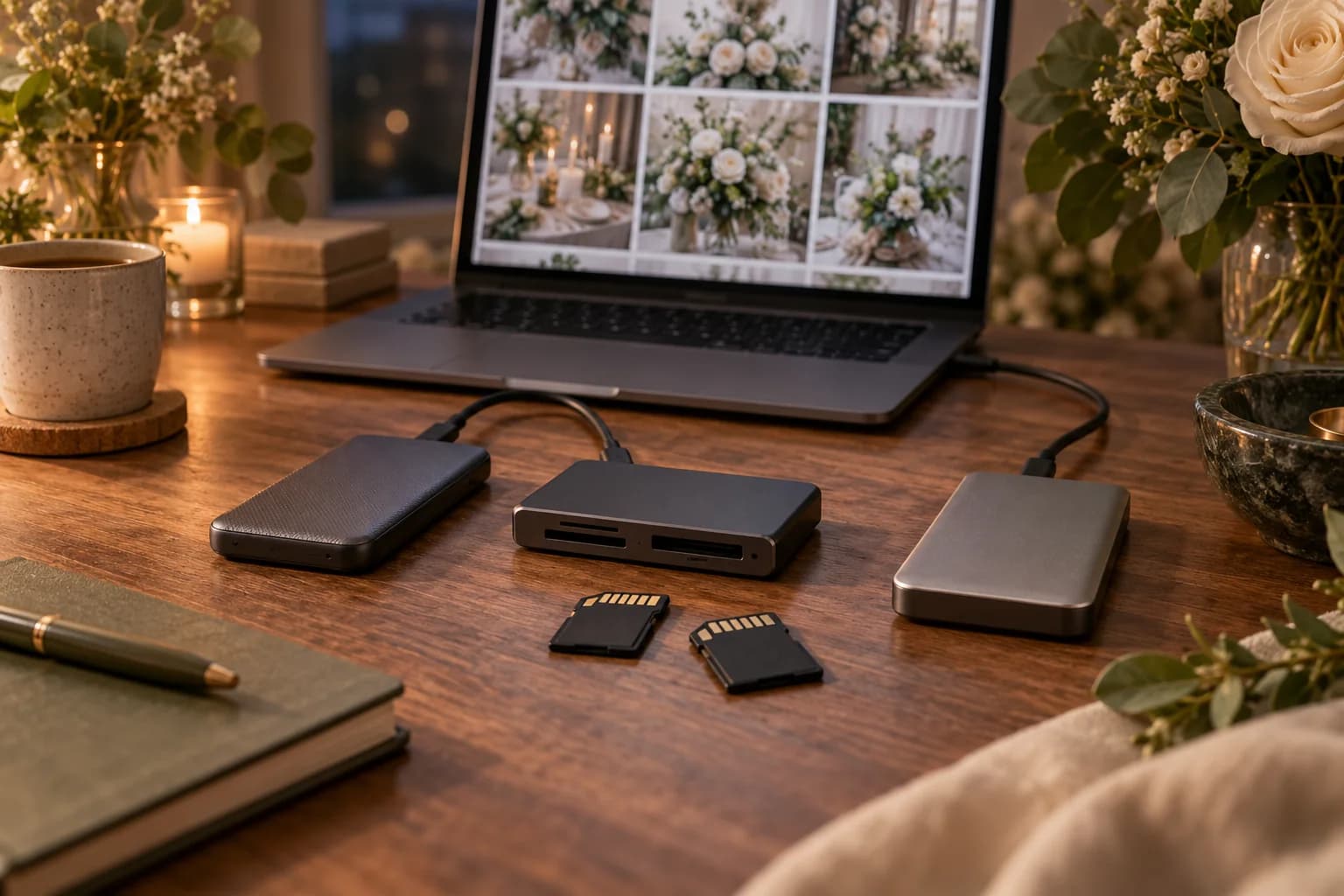
Before I even leave your venue, I do something that would horrify most people: I carry $50,000 worth of irreplaceable memories on two small pieces of plastic in my camera bag.
Every professional photographer shoots to dual memory cards — two copies of everything, in real-time. If one card fails (rare but it happens), the other has your complete wedding.
When I get home — usually midnight or later, often with sore feet and a mild caffeine dependency — the first thing I do is back up both cards to two separate hard drives. Then a cloud backup starts uploading overnight.
Your photos exist in four places before I go to sleep. I don't mess around with this.
Week 1: The Cull
A 10-hour wedding generates between 4,000 and 6,000 raw images.
No, I'm not delivering 6,000 photos. Nobody wants that. Nobody wants to scroll through 37 nearly identical shots of the bouquet toss taken in 0.8 seconds of burst mode.
The first step is culling — going through every single image and selecting the best ones. This means:
- Eliminating duplicates. Of those 37 bouquet toss frames, maybe 3 are great.
- Removing blinks, blurs, and bad timing. Your uncle mid-sneeze during the ceremony. The ring bearer picking his nose. The bridesmaid's hair blowing across her entire face. Gone.
- Choosing the strongest composition. I might shoot the same moment from 3 angles. I pick the one that tells the story best.
- Flagging key moments. First kiss. First dance. Dad's reaction. The moments that need extra editing attention.
This process takes 6–10 hours. Yes, for one wedding. I go through every image individually. It's tedious. It's important. It's the difference between handing you 4,000 random photos and handing you 600 intentional ones.
Weeks 2–3: The Edit
Here's where people think I just click "apply preset" and go to lunch.
I wish.
Color Correction
Every image needs individual color correction. Why? Because the light changed constantly throughout your day:
- Getting ready: warm hotel room lighting
- Ceremony: cool window light mixed with warm candles
- Portraits: golden outdoor light
- Reception entrance: spotlights
- Dance floor: DJ lighting that changes every 3 seconds from blue to pink to green to strobe
I need all of these to look cohesive. Your skin tone should be consistent whether you're in the bridal suite or on the dance floor. The color palette should feel unified across 600+ images.
This isn't a one-click process. It's image by image, adjusting white balance, exposure, contrast, and color tones.
Exposure and Light
Even with perfect settings in-camera, RAW files need exposure adjustments. Shadows need lifting (your black suit at the evening reception). Highlights need taming (your white dress in direct sun). The dynamic range of a wedding day is enormous.
Skin Retouching
Light touch. Always light touch. I'm not airbrushing you into a different person. But if there's a visible blemish that appeared specifically on your wedding day (stress breakout, razor burn, a bruise from walking into the hotel door — it happens), I'll clean it up.
I also reduce under-eye shadows from the 5 AM wake-up and even out blotchiness from crying during the ceremony. You should look like you, just on your best day.
Crop and Composition
Some images need straightening (those horizon lines), tighter cropping (removing distractions), or wider framing (giving room to breathe). This is subtle but it makes a significant difference.
The Special Treatments
Certain photos get extra attention:
- The hero shots (first kiss, first dance, portraits) get detailed editing
- Black and white conversions for timeless moments
- Creative edits for artistic compositions
- Sky replacements or enhancements if the weather was genuinely horrible (rare, but sometimes necessary)
All told, editing a full wedding takes 30–50 hours. That's a full work week. And most photographers — including me — are editing multiple weddings in parallel during peak season.
Week 4: Gallery Building
Once editing is complete, I:
- Export all images in full resolution (300 DPI, print-ready)
- Build your online gallery — organized by wedding day moments (getting ready, ceremony, portraits, reception)
- Set up download access so you can grab the full-resolution files
- Include print ordering if you want professional lab prints or an album
The gallery is private and password-protected. You choose who gets the link.
What You Get
Here's what a typical delivery looks like for me:
- 400–800+ fully edited images (depending on hours of coverage)
- Full-resolution digital files with personal use rights
- Private online gallery for viewing and sharing
- Print-ready files suitable for wall art, albums, and prints of any size
- A curated highlight set of 30–50 standout images (perfect for social media)
You can download everything, share the gallery with family and friends, and order prints directly.
"Can I Get a Sneak Peek?"
Yes. Always yes.
I deliver a sneak peek of 15–25 images within 5–7 days of your wedding. These are fully edited hero shots — your best portraits, the ceremony highlights, a few reception moments.
Why? Because I know you're sitting on the beach in Cancún refreshing your email every 4 minutes. The sneak peek gives you something to post, something to show your family, and something to stare at while you wait for the full gallery.
Why It Takes 4–6 Weeks (And Not 2 Days)
I know. In the age of Instagram, waiting a month for photos feels like waiting for a letter by horse.
Here's the math for peak season (May through October):
- I shoot 1–2 weddings per weekend
- Each wedding takes 40–60 hours of post-production
- That's 80–120 hours of editing work generated per week
- There are approximately 40 working hours in a week
- I also have to sleep, eat, respond to emails, and occasionally see my family
During September and October — the busiest wedding months in NJ — I'm editing constantly. The 4–6 week window isn't padding. It's reality.
Some photographers quote 8–12 weeks. Some quote 3 months. If someone promises same-week delivery for a fully edited wedding, either they're not sleeping or they're not editing.
Things You Can Do While You Wait
- Update your last name on documents (fun)
- Write thank-you cards (less fun but necessary)
- Stare at your ring (free, unlimited)
- Watch your ceremony video if you had a videographer
- Trust the process and stop refreshing your email (I'll email you, I promise)
What If I Need Photos Sooner?
Sometimes there's a reason: a sick grandparent who wants to see photos, a time-sensitive publication, an anniversary gift deadline.
Tell me. I'll prioritize specific images for you. I can pull and edit a set of 20–30 photos in a day or two if there's a genuine need. This has never been a problem.
What I won't do is rush the entire gallery and deliver 600 half-edited images. You'd rather wait and get it right.
The Album (If You Want One)
About 40% of my couples order a professional album. Here's that process:
- You choose your favorites from the gallery (or I curate a selection for you)
- I design the layout — typically 30–40 pages
- You review and approve (usually 1–2 rounds of revisions)
- The album goes to the lab — professional printing, binding, and finishing
- Delivery — 4–6 weeks from the lab
Total time from wedding to album in hand: about 3–4 months. It's worth it. These albums last generations. They're the thing your grandkids will pull off a shelf in 50 years.
The Bottom Line
Your wedding photos don't appear from thin air. They're the product of hours of careful, intentional work — from the backup protocol on your wedding night to the final color correction six weeks later.
When you hire a photographer, you're not paying for someone to show up with a camera. You're paying for the entire process: the anticipation, the execution, the 50 hours of post-production, and the final gallery that makes you relive the best day of your life every time you open it.
I take that seriously. Every wedding, every time.
Questions about the process? Planning a wedding and want to know exactly what to expect? Let's chat. I'll walk you through everything — no surprises, no fine print, just straight talk.